Sahara Mustard
Never doubt that a small group of thoughtful, committed citizens can change the world. Indeed, it is the only thing that ever has.
— Margaret Mead
Don't wait for the cavalry to come over the hill to save you. You are the cavalry and had better save yourselves.
— Robert Lee Paul
Sahara Mustard Overview:
Sahara mustard is one of the most aggressive invasive plants to establish itself in the deserts of the American Southwest. First documented in the United States in the late 1920s, this member of the mustard family arrived without the natural predators and pathogens that kept it in check in its native range. Over the ensuing decades, it spread across millions of acres from California to Texas and from Utah into northern Mexico, transforming desert landscapes and threatening native plant communities. In Borrego Springs, the impact has been particularly visible in the iconic wildflower fields along Henderson Canyon Road, where dense stands of Sahara mustard increasingly replaced the spectacular displays of native spring wildflowers that once characterized the area.
As the invasion expanded, it became clear that traditional control methods—including herbicide applications and manual removal—could provide only temporary relief. Even where local eradication efforts succeeded, new seed sources from surrounding regions quickly reestablished the weed. Recognizing that the scale of the problem demanded a landscape-scale solution, the Tubb Canyon Desert Conservancy launched an ambitious research initiative in 2014 to identify a safe and effective biological control agent capable of restoring ecological balance across the desert ecosystem. Made possible through the generous support of longtime Borrego benefactor Audrey Steele Burnand, the project combined cutting-edge genetic analysis with extensive international field research to identify the origins and natural enemies of Sahara mustard in its native range.
TCDC also built a broad coalition of scientific, governmental, and community partners throughout the American West, ultimately securing the support of more than a dozen members of the U.S. House of Representatives, who urged the U.S. Department of Agriculture to prioritize Sahara mustard in its biological control program. Today, researchers at the European Biological Control Laboratory in Montpellier, France, are using the results of TCDC's groundbreaking research to evaluate promising biocontrol candidates collected in Morocco and Egypt—the source regions of the Sahara mustard populations now invading North American deserts. This work represents one of the most comprehensive efforts ever undertaken to develop a long-term, ecosystem-level solution to one of the Southwest's most damaging invasive species.
Latest News: Sahara Mustard
- 2025: TCDC Announces Completion of Phase II of Quest to Check the Spread of Sahara Mustard
- 2019: Tubb Canyon Desert Conservancy wins Cal-IPC Policy Award
- 2019: USDA-ARS Administrator Commits to TCDC Effort
- 2019: TCDC Wins Bipartisan Congressional Support
- 2018-19: Sahara Mustard, lessons learned
- 2017: Sahara Mustard is in Retreat. Let’s “do something.”
- 2014: Sahara Mustard Update
- 2014: AmeriCorps Silver 6 Team
- 2013: Dodged an explosion of new growth.
- 2013: Sahara Mustard Sprung Up
- 2012: First TCDC Birthday
- 2011: Formation of TCDC
Sahara Mustard (Brassica tournefortii)
Identifying Sahara Mustard (Brassica tournefortii)
Information and photos below describe what Sahara Mustard looks like, as well as what looks like Sahara Mustard, but is not. To see more photos of Sahara Mustard from germination to maturity, visit the Sahara Mustard Life Cycle Slideshow.
The first photo was taken in a sandy wash among mustard-overwhelmed wildflower fields in North Borrego Valley. Note the large, dandelion-like leaves at the base of the airy, broad canopy of stems. In early development there will be tiny yellow flowers on the tips of each stem branch. Lower on the flower stalks, long, skinny seed pods develop that contain tiny, red poppy-like seeds. Flowers and seed pods are often on the plant at the same time. Even small Sahara Mustard plants can produce flowers and seed pods.

An isolated, young Sahara Mustard plant. To pull mustard, grab the main stem or stems as close to the ground as possible, pull with a steady pressure until the long, white, carrot-like taproot pops out of the ground. Wear gloves! Sahara Mustard stems are covered in tiny, prickly hairs that can irritate skin.

A larger, established Sahara Mustard plant. While larger plants produce more seed pods, even tiny mustard plants only a few inches tall can produce seed pods. Fast and early germination, especially in disturbed soils such as the edges of roadways, along with early seed pod production are survival traits of this plant. Sahara mustard pops up first, shades out germinating native plants, thereby eliminating its "competition." Sahara Mustard also goes to seed before most other plants.

Sahara Mustard will eventually smother native plants, even cacti, and kill them by commandeering water with their long, carrot-like tap roots; by blocking sunlight to the victim plants; and perhaps by exuding chemicals that inhibit the growth of other plant species. In this photo, the dense cluster of mustard has been partially cleared away to reveal the barrel cactus and cholla that had been covered by the infestation. Patches of mustard this dense have been growing and reproducing on the site for a couple of years.

Sahara Mustard beginning to take over a phacelia and cholla patch.

Close-up of premature, green Sahara Mustard seed pods or "beans." They look like stiff, skinny, 3-inch long green beans with slightly rounded indentations. Inside a ripe pod are round, poppy-seed size, bright red mustard seeds. One large mustard plant can produce 16,000 seeds! Just think of that every time you pull a plant and stuff it in trash bag! When dry and brown, the seed pods spring open and release their red seeds. There is a sticky coating on each seed that causes it to adhere to animal fur, shoe bottoms, clothing, and vehicle tires. Also, when the mature mustard plant dies and dries out, it become a type of tumbleweed. Wind easily breaks off the dried plant, which gets blown about, spewing seeds into new territory. That is another effective takeover strategy.

What looks like Sahara Mustard, but is not?
The plant below is NOT a Sahara Mustard, though it can look like Sahara Mustard at a glance. This is Desert Trumpet (Eriogonum inflatum), a native desert plant. Note the differences between mustard and this plant: Desert Trumpet has roundish basal leaves with a ripply pattern that does not in any way resemble the oversize, serrated dandelion-like leaves of Sahara Mustard. Also note the tall stems that lack seed pods and that are swollen at their base. Miniature desert poppy and a few other plants can also look like mustard at a glance; however, after studying the leaves and seed pods of Sahara Mustard, it becomes easy to identify the invader.

Close up of the swollen stem base on the Desert Trumpet. There are no alternating mustard seed "beans" on this plant's stems.

Another image of Desert Trumpet leaves and swollen stems.

Photo courtesy of Desert Naturalist website:
For more Sahara Mustard identification photos, visit the Sahara Mustard Info.
Life Cycle of Sahara Mustard
-
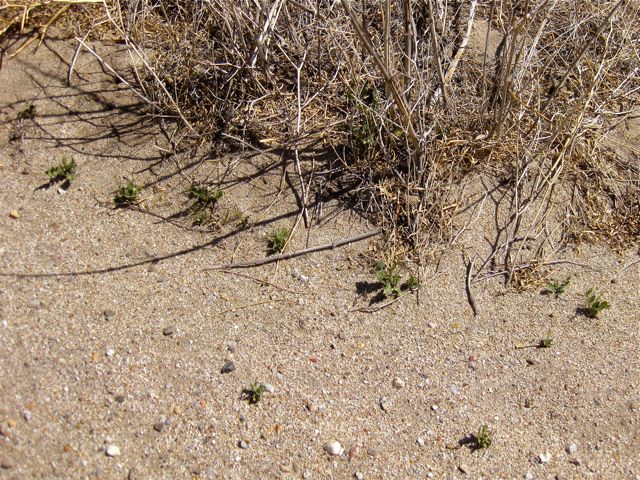
A line of newly germinated baby Sahara Mustard plants that have sprouted up beneath the dried stalks of adult mustard plants from the prior growing season. Sahara Mustard is an annual, which means that adult plants grow, flower, go to seed and then die in one season. The next generation is carried on only by seeds left in the ground. That is why Sahara Mustard seems to disappear, until rain causes it to germinate before wildflowers and other native desert annuals. -
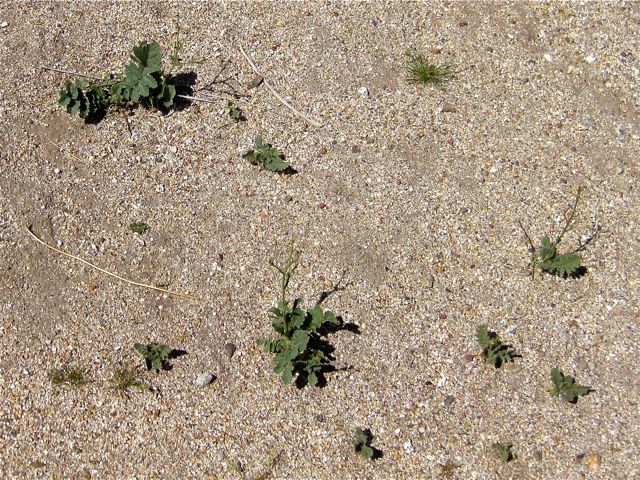
Newly germinated Sahara Mustard in a sandy wash. Note the dandelion-like basal leaves. -
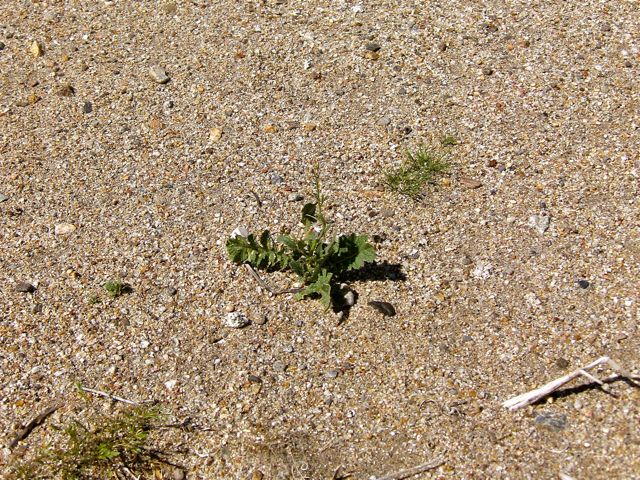
Even tiny Sahara Mustard plants can send up a central flower stalk and produce seed pods, though not as many seeds as much larger mustard plants growing in wetter areas. -
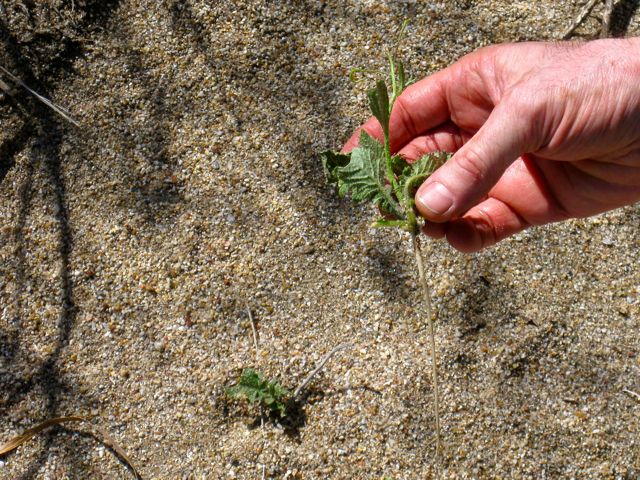
Baby Sahara Mustard plant with a white, carrot-like taproot longer than the above ground portion of the plant. This taproot enables Sahara Mustard to steal water from native plants nearby and to survive drought conditions. -
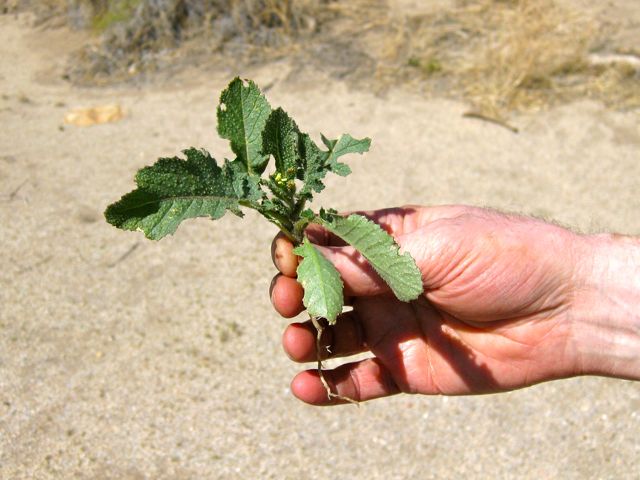
A small, uprooted Sahara Mustard plant up close. The leaves and stems of Sahara Mustard have tiny, prickly hairs that some find irritating, making garden gloves or leather work gloves useful for pulling mustard. -
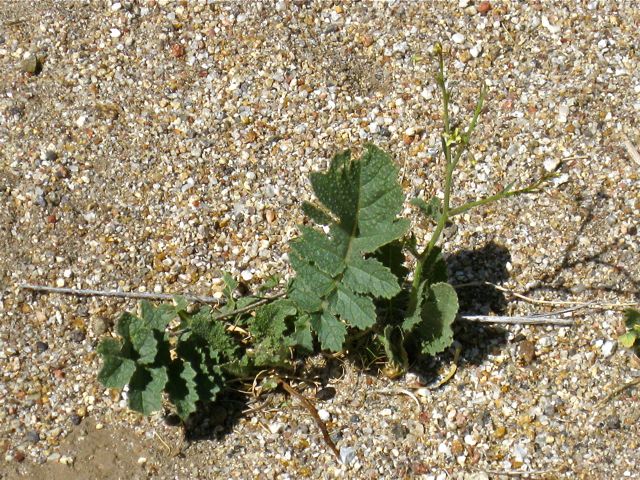
Close up of a young Sahara Mustard with a developing flower stalk on the right side of the plant. -
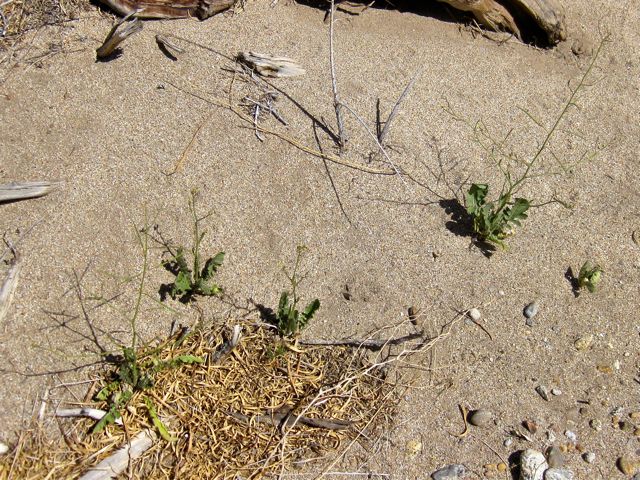
How many Sahara Mustard plants are in this photo? Answer: 5. Sahara Mustard patches can contain plants of various ages and stages of development. Two plants in this photo already have seed pods. Two others are about to flower. One is a tiny baby plant (on the right). -
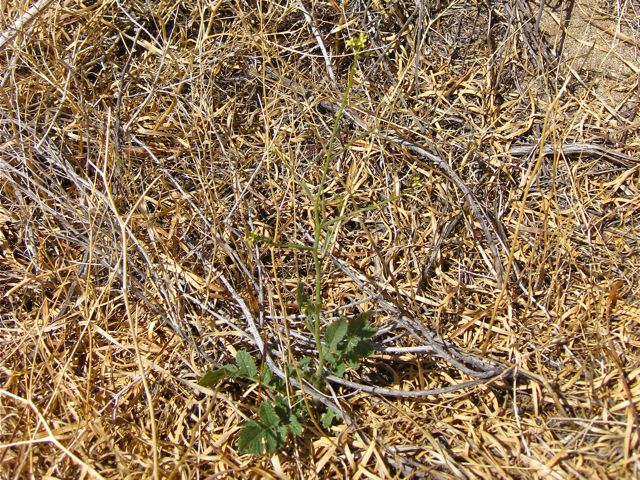
Sahara Mustard often germinates and hides among other plants, including the dead remains of Sahara Mustard from the prior growing season. The Sahara Mustard in this photo has tiny yellow flowers as well as pods lower on its stem. Dead Sahara Mustard from the prior growing season can form a thick mulch that retards the growth of native desert plants and wildflowers. In this way, Sahara Mustard prepares the ground for its own seeds to sprout in the next spring. -
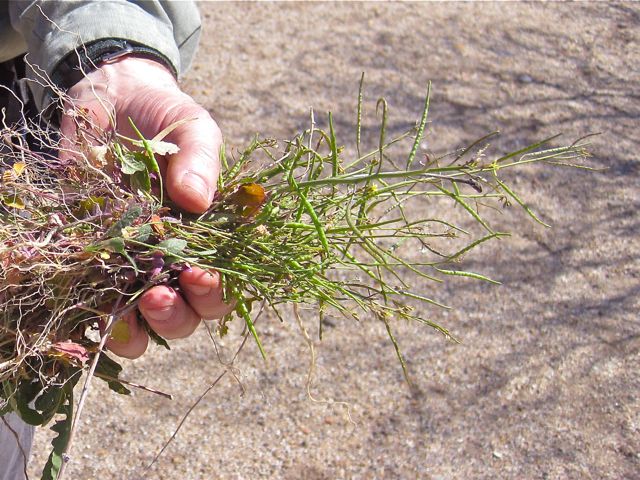
Even small Sahara Mustard plants can produce seed pods containing tiny, round, brick red, poppyseed-like seeds. -
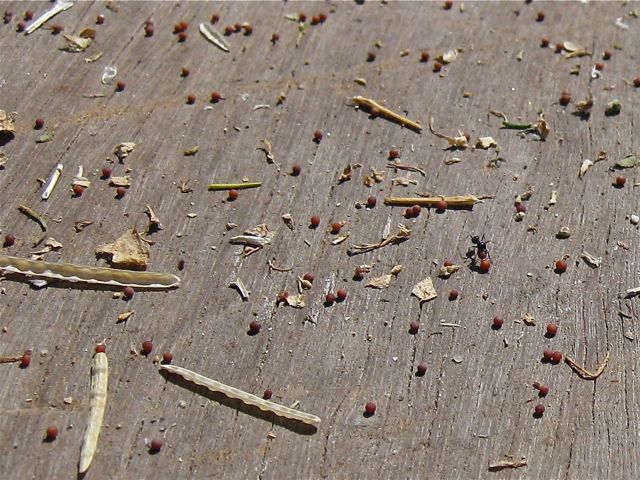
Tiny, round, sticky red seeds of Sahara Mustard among dry pods on an old pick-up truck bed. An ant (right of middle in this image) is picking up a seed. Ants will collect Sahara Mustard seeds and take them down into their colonies. It is unclear if this is good or bad for the germination of Sahara Mustard, though it is suspected that ants aid in removing some seeds by using them in fungus farms underground that feed the ants. Such use would kill the Sahara Mustard seeds. Ants cannot collect all the seeds, though, and many will remain in the ground to sprout and spread in the next rainy season. -
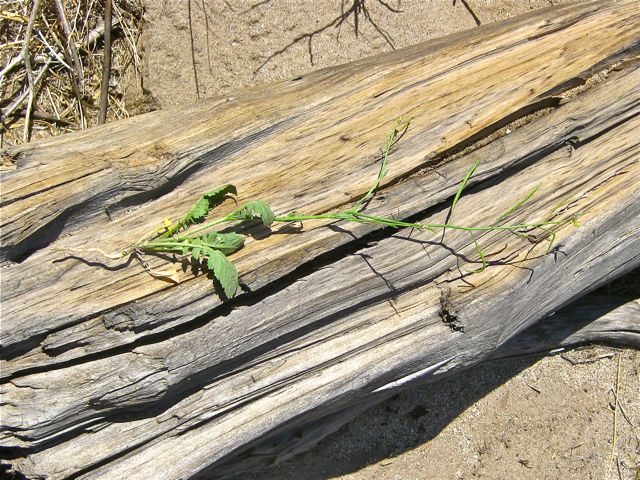
The uprooted Sahara Mustard on the log shows its white tap root on the left, dandelion like basal leaves, and a tall stalk with almost-mature seed pods. When the seed pods ripen, they dry out and pop open, releasing hundred to 15,000 or more seeds per plant. -
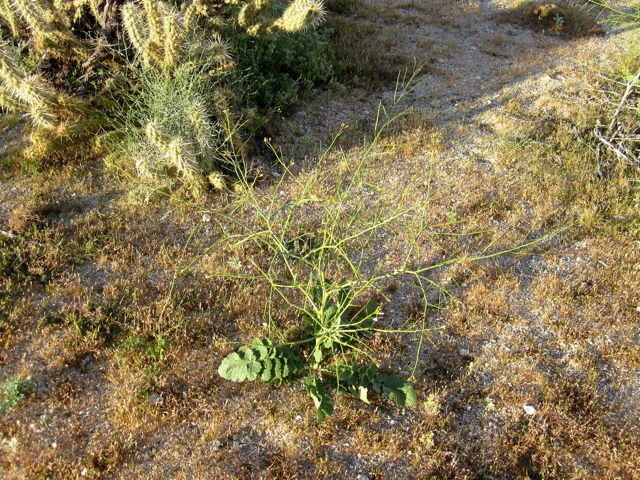
A single Sahara Mustard plant between cactus patches. Tiny little yellow flowers are on the end of some stalks. Lower down on each stalk seed pods are already formed. In the left background Sahara Mustard pods can be seen among a cholla cactus. -
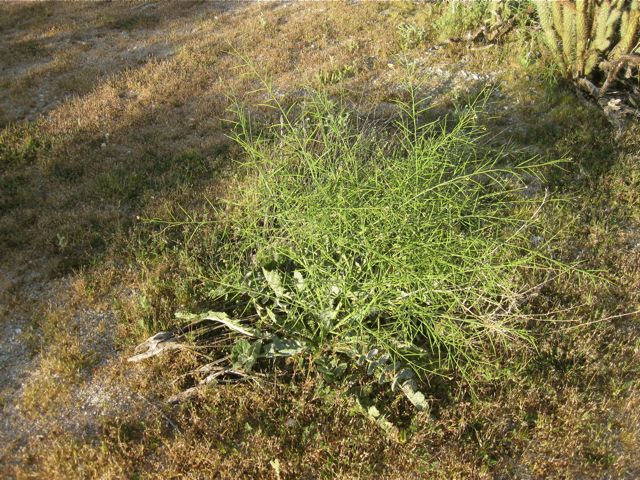
A large Sahara mustard with numerous seed pods ripening. This plant must be pulled and bagged immediately before its pods dry and release up to 15,000 tiny round seeds! -
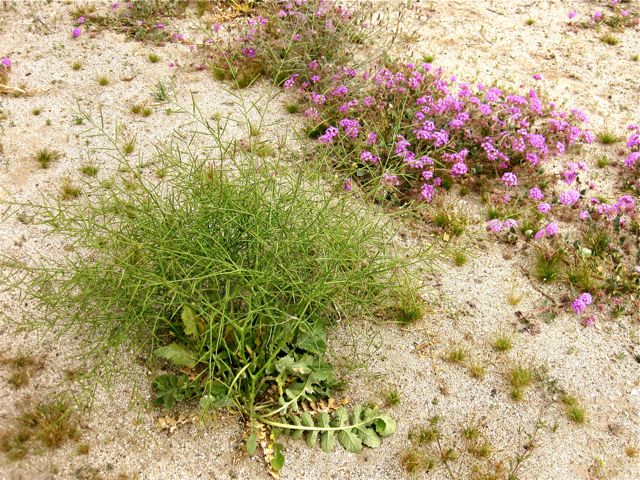
Mature Sahara Mustard, under the right conditions, can grow to be quite large. The small cluster of Sahara Mustard in this photo is full of ripening seed pods that will overwhelm the seeds of purple Sand Verbena growing behind it next spring. This plant must be pulled immediately and bagged to prevent dispersal of its seeds. -
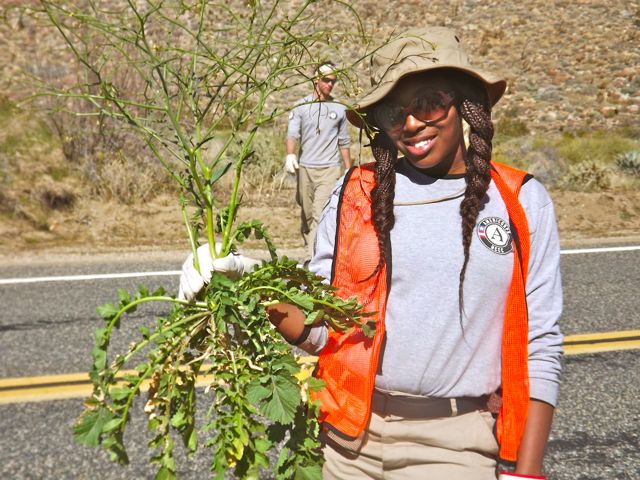
An AmeriCorps volunteer, Canoah Capers, holding a large, mature Sahara Mustard plant with seed pods. Sahara Mustard can grow to be a meter tall. Mature plants remain easy to remove when pulled at their base due to the single, long (carrot-like) tap root in the ground. -
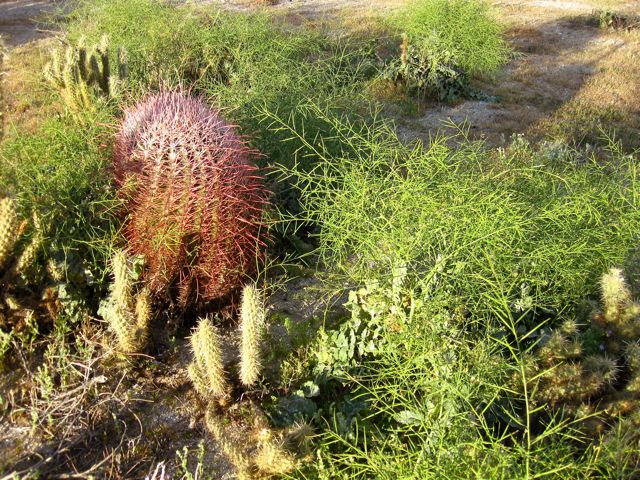
A thick patch of Sahara Mustard taking over a barrel cactus and cholla. All of these mature mustard plants have seed pods. They were pulled, then bagged, immediately after this photo was taken. Left in place to go to seed, Sahara Mustard would eventually kill the barrel cactus and tough cholla cacti by depriving them of water, light and nutrients. Once the cacti, native shrubs and wildflowers are gone, Sahara Mustard will be the only plant left growing in a monoculture, which cannot support wildlife. Desert animals cannot survive eating Sahara Mustard. Without insects, rodents, jackrabbits and birds, even predators such as lizards, snakes, coyotes and bobcats will move away or die, resulting in a silent spring across a desert wasteland that grows only Sahara Mustard. -
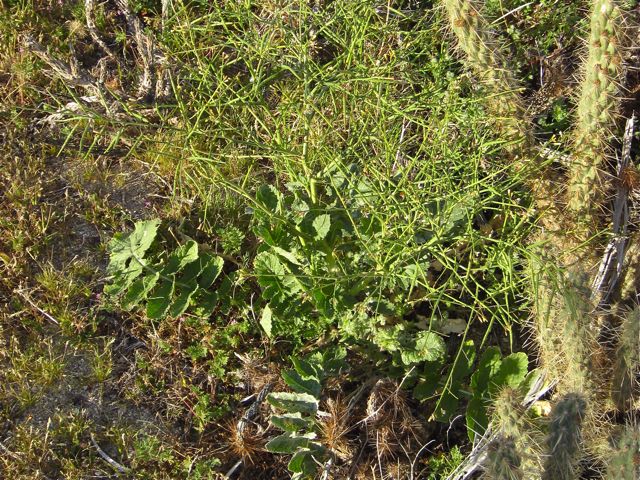
Close up of a mature Sahara Mustard with seed pods that is shading out desert plants and taking over cholla cactus.
No Mustard Left Behind Campaign
Mustard Busting: The Movie. Robert L. Staehle pulling Sahara Mustard from the Anza Borrego Desert.
Successful Sahara Mustard Removal from Tubb Canyon Bajada
March 2011
Over several weekends in March and early April of 2011, Tubb Canyon landowners, with help from a small, but dedicated crew of hired workers and volunteer friends, cleared over 200 acres of Sahara mustard from Tubb Canyon Bajada on both private, protected land and within Anza-Borrego Desert State Park from Tubb Canyon eastward to Borrego Springs Road. This special project was reported in the Borrego Sun article, "Tubb Canyon residents rally to fight mustard."
Anza-Borrego Desert State Park does not have the budget to clear park boundaries and visitor destinations where Sahara Mustard invasion has been hastened by cars, especially off-road vehicles, bringing in Sahara Mustard seeds. The densest infestations of mustard are along paved and unpaved roadways, radiating out 100 yards from the side of roads. Next year, that zone of mustard will probably extend to 120 or 150 yards from disturbed soils along road sides... and grow faster and farther each year no one takes action.
Together, all of us who care about the desert can stop the mustard invasion, but only if everyone does their part... Right now, that is not happening. Many residents and visitors remain unaware of the mustard invasion. Many others are in denial regarding the threat posed by Sahara Mustard, or, they feel the situation is hopeless. As dire as the Sahara Mustard takeover has become, it is still stoppable if we act quickly!
If a few landowners with a small crew of workers and friends can clear hundreds of acres of Sahara Mustard in a few weekends, than imagine what can be accomplished if Borrego Springs residents and visitors all dedicate themselves to pulling mustard next season! This is a call to arms for neighbors, students, civic clubs, local businesses, and visitors to join a "No Mustard Left Behind" campaign.
Local businesses can "adopt" stretches of road or an acre of wildflower fields and clear those areas with employee volunteers or by funding a crew. That's positive PR and will help protect the natural resources that bring business to town. No wildflowers or desert beauty... No visitors. Losing our desert to Sahara mustard is too awful to contemplate. Gone forever would be the beauty and biodiversity of our Sonoran desert. Wildlife would die due to loss of habitat, and the resulting wasteland of dry Sahara Mustard would become a serious fire hazard that would threaten local homes and parkland. Borrego Springs may not survive if it loses income from tourists no longer visiting during wildflower season.
The success of the Tubb Canyon effort can be replicated, acre by acre, across Borrego Valley and into Anza-Borrego Desert State Park. We urge everyone who cares for the survival of the desert to step forward and become involved in eradicating Sahara Mustard wherever it is found.
-

David Garmon, TCDC President, with a crew of "Tubb Canyon Mustard Busters" enjoying their box lunch break. Lunches and snack bags were generously donated by a local Borrego Springs country club for those pulling mustard. -

Robert Staehle, TCDC Vice President, collecting bags full of Sahara Mustard. -

A male Gambel's Quail visited during mustard removal. -

Bags of Sahara Mustard pulled from within Anza-Borrego State Park were staged along Tubb Canyon Road for pick up and disposal in the commercial dumpster at park headquarters. -

Lori Paul, Member of the TCDC Board of Directors, collecting bags full of Sahara Mustard for pick up. (Photo courtesy of Frank Gilman) -

Bags of Sahara Mustard pulled from within Anza-Borrego State Park were staged along Tubb Canyon Road for pick up and disposal in the commercial dumpster at park headquarters. -

Work continued into twilight on several days... -

Neighbors brought their trucks and cars by to pick up bags full of Sahara Mustard for transport to the disposal site at park headquarters. -

Neighbors brought their trucks and cars by to pick up bags full of Sahara Mustard for transport to the disposal site at park headquarters. -

A full load on its way to the dumpster! -

ne weekend's worth of "mustard busting" from Tubb Canyon Bajada overflowed the commercial dumpster at Anza-Borrego State Park Headquarters. -

The sign on the dumpster said, "Sahara Mustard Only Please! Thank You!" We obliged... -

Intrepid Mustard Busters at the State Park dumpster after dropping off the last bags of the day. (Photo courtesy of Thor Myhre)
Final Thoughts...

BEFORE/AFTER
These two pictures were taken on 26 March 2011 during the clearing of Sahara Mustard along Tubb Canyon Road. The left picture is the "before clearing" picture. The right picture is the "after clearing" picture. "If we elect to do nothing, if we delay action for too long, I fear these pictures will be reversed: the "before" picture being the lovely cactus blossom, the "after" picture being the strangulation of wildflowers, shrubs and cacti by the invading horde of Sahara Mustard."
-- David Garmon, President of Tubb Canyon Desert Conservancy
Special note regarding the value of pulling Sahara Mustard once seed pods ripen on the plant:
Mature Dried Sahara Mustard Management:
If you were not able to pull or spray the plants while they were green in spring, you still have a chance to manage the plant through the summer by gathering the dried seed stalks that still have intact seedpods attached... Since the strain that is spreading across North American deserts seems to be a cultivar, in that the seedpods do not readily dehise (burst), numerous seedpods remain intact into mid-September. This allows additional months for harvesting a lot of the seed before it spreads into the environment...
Excerpt Courtesy of EcoSeeds Sahara Mustard
Frequently Asked Questions
-
What is Sahara Mustard?
Sahara Mustard is a fast-growing, tough, desert-adapted foreign weed which is taking over much of the Sonoran and Mojave Deserts across the U. S. Southwest. It is a "winter annual," meaning that the plant germinates during winter rains, grows to maturity quickly, sets thousands of seed for the next generation, then the parent plant dies, often breaking off in high wind to become a dry "tumbling weed" that spreads its seeds wherever it is blown.
-
Why is Sahara Mustard a problem? Isn't it just another desert plant?
Sahara Mustard is a bright green plant with a basal rosette of large, dandelion-like leaves. Above the large basal leaves grows a canopy comprised of numerous, nearly leafless thin stems that sprout branches with tiny pale yellow flowers on the their ends. These flowers are self-pollinating, so each flower will develop a long, thin green bean-like pod full of tiny poppy-like red seeds. Sahara Mustard plants mature enough to produce seed pods can be small (6 inches high) to large (2 feet wide and up to 4 feet tall) depending upon their age and growing conditions. Masses of bright green Sahara Mustard can have the appearance of a shrub or hedge when seen from a distance.
-
Does Sahara Mustard really come from the Sahara Desert in Africa? Does it have any other names?
Sahara Mustard (Brassica tournefortii) is a common native mustard in the semi-arid and arid deserts of Northern Africa, including regions of the Sahara Desert; however, it is also found in parts of the Middle East, Pakistan and in drier Mediterranean regions of Southern Europe, where it may be a recent "colonist."
Sahara Mustard is known by several common names, including:
- Asian Mustard
- Moroccan Mustard
- Desert Mustard
- Mediterranean Mustard
- Mediterranean Turnip
- Wild Turnip Weed
- Prickly Turnip
In Spanish, Sahara Mustard is known as Mostaza del Sahara or Mostaza del Desierto.
- Asian Mustard
-
What does Sahara Mustard look like, including its seeds?
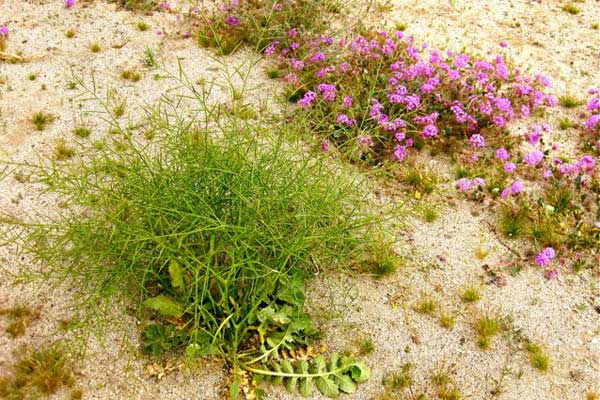
Sahara Mustard (Brassica tournefortii) growing next to desert sand verbena (Abronia villosa) with purple blooms in Borrego Springs, California.
For further information, see Identifying Sahara Mustard and
the Sahara Mustard Life Cycle Slideshow. -
Why don't I see Sahara Mustard all the time? I went out into the desert, but can't see any evidence that Sahara Mustard is "taking over."
Large, green Sahara Mustard plants can only be seen during the desert growing season after winter and/or spring rains. Sahara Mustard is a "winter annual." After going to seed, the parent plant withers and dies. During hot summer months, before sufficient rain enables Sahara Mustard seeds left in the soil to germinate anew, adult Sahara Mustard plants die and "disappear" from view.
If one knows what to look for, though, evidence of Sahara Mustard infestation can be seen year-round in the form of dead, white "sticks" left standing where the parent plant once grew (see photo below). Those 8 to 12 inch (20 to 30.5 centimeter) white sticks are all that remain of the main stem of a Sahara Mustard plant after its more fragile canopy of branches has died and broken off. Large mustard plants can dry into white "tumble weeds" of a few dead branches that blow around in the wind and can be seen trapped among cacti, creosote bushes, and other vegetation.
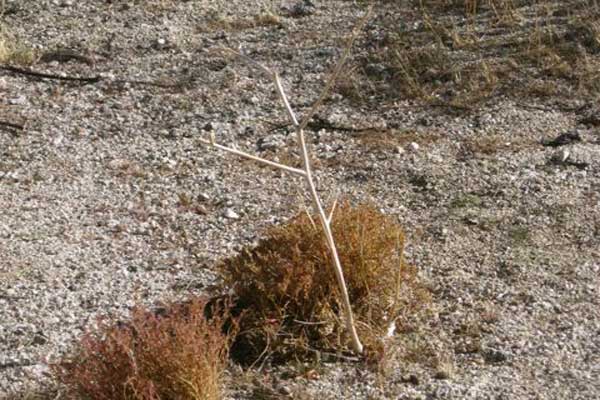
The dead, white stick in the center of the above photo is all that remains of Sahara Mustard after it goes to seed and the parent plant dies. These "white sticks" are evidence that an abundance of dormant mustard seeds are in the ground at that location, awaiting the next rainy season to germinate.
Though Sahara Mustard cannot be seen as a large, green plant for much of the year, do not be deceived! Sahara Mustard seeds in the ground will germinate quickly after rain and continue to takeover native wildflower fields, invading deeper into the desert with each passing growing season.
-
How does Sahara Mustard spread so fast? What distributes its seeds so far across the desert?
Sahara Mustard evolved in a very harsh desert environment. It's survival strategies include fast germination and growth, so that it can out-compete other seedlings and grow large enough to overshadow other plants, depriving them of needed sunlight. Sahara Mustard also grows a long, carrot-like taproot that commandeers water for its own growth while desiccating nearby plants. There is also some evidence that Sahara Mustard exudes chemicals into the soil which inhibit growth in other plant species, including tough desert shrubs such as creosote and some cacti. Sahara Mustard matures quickly and is capable of producing seed pods under adverse conditions, such as nutrient-poor soil or direct sun and wind.
Sahara Mustard seed pods produce thousands of tiny, round red seeds. Each seed has a sticky, mucilaginous surface that readily "hitches a ride" on animal fur... or a desert visitor's shoes, clothing, and vehicle tires. Eventually the seeds fall off in a new location, thereby pioneering a new infestation site. Some mustard plants at the end of their annual life cycle also break off at the main stem in wind and become tumbling weeds that throw seeds into new locations as the plant is blown around.
With no major natural enemies in our deserts, this foreign weed's numerous survival traits make a formidable invader capable of killing native desert vegetation and replacing it with a Sahara Mustard wasteland devoid of wildflowers, butterflies, birds and other wildlife.
-
What will happen if Sahara Mustard is not controlled?
Sahara Mustard threatens to bring a real "Silent Spring" to the Anza-Borrego Desert and other deserts of the Southwest. Sahara Mustard quickly multiplies to overshadow, poison, and rob water from the wildflower fields and blooming cacti that bring so many visitors from around the world to see the. Eventually, Sahara Mustard can kill even tough creosote, cholla and barrel cacti, literally taking over the desert and turning it into a mustard wasteland devoid of the biodiversity needed to sustain desert wildlife, from butterflies to lizards, pocket mice to owls, hummingbirds to bobcats, roadrunners, quail, and all the others. Without the wildflowers, shrubs and cacti in our landscape, there will be no bird songs, no chorus of frogs on spring nights... and no human visitors... in a decimated ecosystem.
-
How, where & when did Sahara Mustard get into North American deserts?
Sahara Mustard seeds probably "hitchhiked" to the Desert Southwest as a contaminant in a variety of crop seed shipments or perhaps arrived on date palm seedlings. Sahara Mustard may have been present in the Coachella Valley as long ago as 1927. In 1957 Sahara Mustard was identified along Mexico Highway 2 near the U.S. border, growing along the road where Mexico Highway 2 becomes U.S. Route 95 near Yuma.
By the 1970s Sahara Mustard had spread into low elevation, arid deserts across Arizona and southeastern California in the U.S. It was also identified in Baja California and Sonora, Mexico. At that time, though, Sahara Mustard was confined to dense patches in sandy washes and disturbed soils, such as roadsides, in off-road vehicle recreational areas, and in sand quarries or "borrow pits." Sahara Mustard had not yet invaded undisturbed, natural desert habitat, nor did it appear to be taking over entire regions at a rapid rate.
Around 1997 a devastating change seems to have occurred. What is now thought to be a pernicious new Sahara Mustard strain appeared. "Ground Zero" for this more aggressive form may have been in Riverside County near the junction of California State Routes 177 (Desert Center Rice Road) and 62 (Twentynine Palms Highway) on the eastern edge of Joshua Tree National Park, California. This adaptable variant of Sahara Mustard exploded beyond isolated sandy washes and disturbed areas and rapidly began invading deep into natural desert vegetation. It even began appearing at higher elevations and in rockier terrain than prior forms of Sahara Mustard. According to Craig Dremann, owner of The Reveg Edge / Ecoseeds Environmental Services, who has surveyed Sahara Mustard infestations in the field, this "new" type of Sahara Mustard could be identified not only by its greater invasive habits, but also by its unique, brick red color seeds that are unlike any of the Sahara Mustard seeds in USDA collections. This is the Sahara Mustard which now threatens both the great Mojave and Sonoran Deserts of the U.S. and northern Mexico.
It is now believed that the practice of using desert sand and gravel from "borrow pits" for construction fill has been responsible for transporting highly invasive Sahara Mustard seeds far distances. Wherever mustard seeds dropped off of trucks and tires, or were dumped with fill sand and dirt, there Sahara Mustard has germinated and quickly established itself. Urban and suburban areas around Tucson, Arizona, for example, have been highly colonized by Sahara Mustard, which has radiated quickly from those locations to take over adjacent wild desert. Off-road vehicles are another major "carrier" of Sahara Mustard into wild desert habitat and popular recreational destinations.
Budget-strapped government agencies, land managers, and academics sounded the alarm about Sahara Mustard by 2003, but failed to take coordinated, extensive and effective action against growing Sahara Mustard infestations. Part of their complacency may have resulted from the fact that Sahara Mustard is an annual that "disappears" and can remain dormant in a seed bank during years of extreme cold or drought. In addition, in spite of research data and warnings from academia, there has been little money allocated for comprehensive control of this weed, which has allowed Sahara Mustard to become a growing ecological disaster across the entire desert Southwest.
The Sahara Mustard invasion became noticeable in the Anza-Borrego Desert around 2005, with the weed rapidly expanding its range since that time into Borrego Valley and the surrounding state park. Mustard seed-contaminated construction fill and date seedlings, along with seeds transported by tourists on their vehicles and camping equipment, and off-road vehicles have "inoculated" popular desert destinations and continue to spread Sahara Mustard. From both paved and unpaved roads, mustard radiates out to overwhelm wildflower fields and the open desert.
To date, Sahara Mustard has moved into the Sonoran and Mojave Deserts in southeastern California; southern Nevada (at the confluence of the Great Basin, Mojave and Sonoran Deserts); Baja California and Sonora, Mexico; eastward into Arizona with an increasing number of plants being found in extreme southwestern New Mexico and parts of southern Utah.
TheFederal Interagency Committee for the Management of Noxious & Exotic Weeds (FECMNEW) conducted a recent inventory of land management agencies in California and Arizona, the two states hit most severely by Sahara Mustard infestation. According to their report, Sahara Mustard has invaded numerous parklands, including (in alphabetical order):
- Anza-Borrego Desert State Park, California
- Death Valley National Park, California
- Grand Canyon National Park, Arizona
- Joshua Tree National Park, California
- Lake Mead National Recreation Area, Arizona & Nevada
- Mohawk Dunes, Barry Goldwater Air Force Range (Luke Air Force Base), Arizona
- Mojave National Preserve, California<
- Organ Pipe National Monument, Arizona
-
Isn't there an herbicide or other agricultural chemical that can destroy Sahara Mustard?
Yes. There are many herbicides that can kill Sahara Mustard. Unfortunately, those chemicals are even more toxic to native desert plants than to the mustard. The "cure" turns out to be more fatal than the "disease" to fragile wildflowers and other native vegetation, including barrel cacti and most herbaceous shrubs. There is ongoing research to find a targeted herbicide that can be applied at just the right time to kill germinating Sahara Mustard, but not harm annual wildflowers or other plants. Thus far, research in this area has been very disappointing. A chemical that kills only Sahara Mustard and does no harm to other plants would be a panacea, but no such treatment yet exists.
-
Don't rabbits, deer & bighorn sheep eat Sahara Mustard?
There is little data regarding what animal species consume Sahara Mustard. It has been observed that rabbits will occasionally nibble on young Sahara Mustard seedlings; however, it is clear that rabbits and other herbivorous foragers eat little, if any, mature Sahara Mustard. Deer and bighorn sheep occupy higher elevation habitats where Sahara Mustard has begun to invade; however, it does not appear that the mustard is consumed at all by these large browsing species. Like many mustards, Sahara Mustard is high in oxalic acid and may be too bitter and unpalatable to most wildlife.
-
Can't domestic goats be used to get rid of Sahara Mustard?
Goats are not the answer to eliminating Sahara Mustard. While they may be able to survive by eating some mustard, goats greatly prefer grazing on more palatable native plants first. Goats and other livestock would cause serious damage to desert vegetation and stable soil surfaces long before they would have any beneficial impact on Sahara Mustard growth. Some seeds passing through a goat's digestive tract may remain viable, transporting some seeds to wherever a goat goes next.
-
Do wild birds eat Sahara Mustard or its seeds?
Little is known about whether or not wild birds consume Sahara Mustard, including its red seeds. It does not appear that Sahara Mustard's round red seeds are palatable to local seed-eating bird species, such as sparrows, towhees, finches, warblers, doves, and quail. Even if birds occasionally eat Sahara Mustard seeds, their consumption does not appear to have a significant effect on reducing mustard reproduction. It is known that areas completely taken over by Sahara Mustard lose resident and migratory birds. Where nothing besides Sahara Mustard grows, birds and other wildlife cannot thrive and biodiversity is lost.
-
Are there no natural enemies of Sahara Mustard?
As a foreign plant, Sahara Mustard has been removed from the ecosystem in which it evolved. Where mustard originated in Africa and the Middle East, there are undoubtedly insects, larger animals, and competitive plants that keep Sahara Mustard in check; however, those species do not exist naturally in the Southwestern United States where Sahara Mustard is not native.
If there is a "natural enemy" of Sahara Mustard it is a healthy, balanced desert ecosystem. Just the way a stressed, malnourished or unhealthy person is more susceptible to catching an infection, desert habitat that has been grazed (even a century before), damaged by off-road vehicles, excavated, or traversed by roads, is far more vulnerable to Sahara Mustard takeover.
There are native plants that seem to exclude or resist Sahara Mustard incursion, such as species of phacelia (wildflowers commonly known as "fiddleneck"). Phacelia campanularia (Desert Bluebell), P. distans (Wild Heliotrope), P. crenulata (Notch-leaf & Cleft-leaf Phacelia), and P. minor (Canterbury Bells) are all common in healthy Anza-Borrego Desert habitats. More study is required to identify natural assemblages of native plants, including annuals, perennials, shrubs, trees, succulents and cacti, that are most resistant to Sahara Mustard invasion.
Interestingly, a non-native, invasive crop pest that consumes mustard (Brassica) species, including Sahara Mustard, arrived in Los Angeles County back in 2008.* The Bagrada Bug, also known as the Painted Bug, (Bagrada hilaris) is a stink bug native to eastern and southern Africa, southeastern Asia, and southern Europe (primarily Malta and Italy). Sahara Mustard is native to many of these same regions. The foreign Bagrada Bug has invaded low deserts and Coachella Valley crops and appears to be rapidly spreading across California, parts of Nevada, Arizona and New Mexico. Thus far, Bagrada Bugs are not apparent in the Anza-Borrego Desert, but that situation may change soon.
Bagrada Bugs are not deterred by desert heat and aridity. Birds and other wildlife seem to find Bagrada Bugs distasteful. It is not clear what native desert plants this pest species might favor. Introduced Black Mustard (Brassica nigra) that is common in California foothills, along with Sahara Mustard (Brassica tournefortii), may become significant targets, as well as potential reservoirs, for this highly invasive stink bug that damages cruciferous vegetables (broccoli, cauliflower, kale, cabbage, etc.), cotton, strawberries and other important food crops.
Though Bagrada Bugs will consume Sahara Mustard, because these bugs also threaten numerous food crops, they are not a desirable biocontrol for mustard. It remains to be seen if a Bagrada Bug invasion into desert ecosystems will have a significant impact on the spread of Sahara Mustard across the Southwest.
For more information about Bagrada Bugs and a slideshow of photos, visit the University of California at Riverside's Center for Invasive Species Research Bagrada Bug page.
Note that the immature nymphs of the Bagrada Bug are round and bright red (circled in the photo). When seen from a distance these nymphs can be mistaken for beneficial ladybugs.
* “Bagrada Bug,” Richard W. Hoenisch; UC Davis, Western Plant Diagnostic Network, Mar 2012
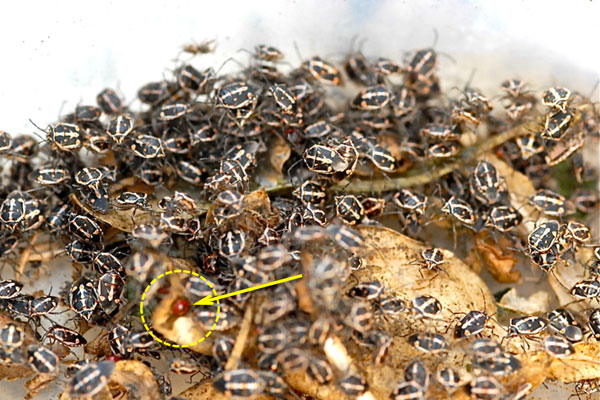
(Photo courtesy of Steven R. Kutcher, taken in the foothills of Arcadia, CA, 2012, where Bagrada Bugs have attacked Black Mustard)
-
Why do ants carry Sahara Mustard seeds back to their colonies underground?
It has been observed that native ants are highly attracted to Sahara Mustard seeds. When an ant encounters a red mustard seed, it will often pick the seed up and carry it back to its underground colony. It is not clear why ants do this. They may be consuming some portion of the seeds or destroying collected seeds by "farming" fungi on them underground. The fungi cultivated on seeds and other organic detritus by ants is, in turn, harvested and eaten by the ants... If this is the case, then native ants may help remove thousands of mustard seeds that might otherwise germinate.
More ominously, Sahara Mustard seeds may exude an ant attractant that encourages ants to carry the seeds underground where they are more likely to germinate. Some plant species disperse their seeds by offering ants an attractive, edible coating or part on their seeds. This is known as myrmecochory. Ants will carry seeds underground, consume the tasty coating or part, leaving the seed viable in a nutrient rich, safe location where it can germinate. Sahara Mustard seeds do not appear to have any "ant candy" attached to their structure, but this does not mean that mustards do not entice ants in some way to help them sew their seeds underground.
Further study of ant interactions with mustard seeds is needed to determine whether ants are natural enemies.... or inadvertent allies... of invading Sahara Mustard.
-
Fighting Sahara Mustard seems hopeless... What can be done to save the desert?
Fighting Sahara Mustard seems hopeless...What can be done to save the desert?
While the destruction of wildflower displays and native desert ecosystems is growing more imminent with every season Sahara Mustard multiplies and spreads, it is not yet too late to save the desert. Hundreds of acres in the Anza-Borrego Desert near Tubb Canyon have been cleared of Sahara Mustard. What is required is dedicated effort on the part of all those who care about the desert to hand-pull Sahara Mustard plants before they go to seed. Every mustard that is pulled and destroyed is one more plant that will not produce thousands of seeds. While the task seems overwhelming, it is not difficult. If everyone gets involved to clear a patch of desert land; if we all support teams of volunteers and workers to clear land of mustard, the desert can be reclaimed one wildflower patch and one acre at a time.There are no government agencies, universities, nor nonprofit conservation organizations who can single-handedly stop Sahara Mustard from destroying the desert. Only by all of us getting involved and working together... to hand-remove mustard now, to study the problem and seek innovative methods of controlling Sahara Mustard in the future, and by restoring healthy desert habitat... only then will we be successful in protecting our vulnerable, beautiful deserts.
Drop by single drop are powerful rivers formed! Each of us as an individual matters greatly in the fight against Sahara Mustard, whether by pulling a mustard plant from beside the road, clearing all the mustard from a favorite patch of wildflowers... Or by making a small donation, educating others and/or writing a letter of concern.
For further information, see Identifying Sahara Mustard and No Mustard Left Behind. Please explore Ways to Help and Donate to TCDC! Become a Desert Guardian and participate in the easy to use TCDC Mustard Map App.
-
I'd like to help stop Sahara Mustard, but I cannot physically pull mustard myself... and I don't have a lot of money to donate for mustard removal teams or programs. Is there anything else I can do to help?
Yes! There are many ways to help eradicate Sahara Mustard that do not involve physical labor or contributions of money. Volunteers are needed with a variety of skills and expertise.
Everyone can greatly assist efforts to eliminate Sahara Mustard simply by bringing this ecological disaster to the attention of family, friends, news media, and local officials. The more residents and desert visitors request action to stop Sahara Mustard, the more likely it becomes that reporters, organizations and government agencies will pay attention and allocate funds for eradication programs and needed research.
Please visit Ways to Help or contact TCDC. We will be happy to explore ways you can become involved in saving the desert that match your abilities, available time and resources!
-
How can I pull Sahara Mustard and dispose of it properly?
Pulling Sahara Mustard is easy, if repetitive, physical labor. Once the mustard plant has been identified, grasp it at the base of its main stem with a gloved hand (mustard stems are covered with tiny hairs that can irritate the skin of some people). Pull steadily on the mustard's stem until the entire plant is pulled out of the ground by its pale, carrot-like tap root. Turn the mustard upside down and stuff it into a sturdy trash bag. Be particularly careful if there are nearly mature seed pods on the plant to get the entire plant, intact, into the trash bag. Keep adding mustard plants until the bag is full, then tie the top of the bag closed with a tie wire or other secure means.
For further information, see Identifying Sahara Mustard and No Mustard Left Behind.
-
If I pull and bag Sahara Mustard where can I dispose of the bags so no seeds escape into an open land-fill?
Always seal trash bags containing Sahara Mustard securely with twisty wire or string or adhesive tabs. Do not rely only on draw-string pull ties which may leave a small opening where seeds can fall out or that might come undone, opening a bag in transport or when knocked over by wind. It is important to keep plants with seed pods and seeds completely contained.
If only a few bags of mustard have been pulled around a desert home or business, it should be fine to dispose of them via regular trash pick-up. Large quantities of Sahara Mustard pulled in the Anza-Borrego Desert and securely bagged may be taken to the Anza-Borrego Desert State Park Headquarters near the park Visitor Center for disposal in dumpsters signed for Sahara Mustard. Do not transport loose bundles of Sahara Mustard to any disposal site! Always place mustard plants in secure, well-sealed trash bags. Patch any holes in bags where seeds might escape with shipping or duct tape (not scotch or masking tape). For bags that have large holes or tears, carefully place the damaged bag in another bag, then tie the doubled bag closed before disposal.
-
Is it true that Sahara Mustard is edible?
Like spinach, chard, parsley, sorrel, and beet greens, Sahara Mustard leaves are high in oxalic acid, which imparts a sharp, bitter taste. Rhubarb leaves are so high in oxalic acid that they are toxic when consumed in large quantity. Nevertheless, according to the Global Invasive Species Database excerpted below, cooked Sahara Mustard greens are edible. *Please note: None of us at TCDC have actually eaten Sahara Mustard; we are only citing reports from others whom we do not know personally.
The Plants For A Future Database (1997) states that the leaves of Brassica tournefortii can be used to create various oils. The authors state that the leaves and young shoots can be cooked, and edible oil can be obtained from the seed. Dr. Khaled O. Abukhabta (pers. com. 2005) reports from Libya that it is widely used as food, mixed with kuskus (couscous) and some other spices to give it a very good flavour. He adds that in addition to it's mild laxative effect (due to a high content of beneficial fibers), it contains 3-methylsulfinylpropyl glucosinolate, which reduces the risk of cancer of the lung, stomach, colon and rectum, with a possible reduction in endometrial and ovarian cancer and a decrease in total cancer incidence.
No one seems likely to publish a "Sahara Mustard Cookbook" anytime soon! If someone has eaten Sahara Mustard and can recommend a recipe, TCDC would like to hear from you!
Online Resources
- ABDNHA Sahara Mustard Life Cycle Photos
- California Invasive Plant Council: Cal-IPC
- EcoSeeds Sahara Mustards in the USA
- University of California Davis IPM Online: Statewide Integrated Pest Management Program
- University of California Riverside Center for Invasive Species Research (including slideshow)
- USGS Sahara Mustard (Brassica tournefortii) Along Desert Roadsides
Research Publications
(in order of publication date)
Phase II
- Human-Mediated Dispersal Routes Structure Sahara Mustard Genomics Results of Phase II, published in Molecular Ecology
Phase I
Multiple introductions and population structure during the rapid expansion of the invasive Sahara mustard (Brassica tournefortii) Daniel E. Winkler, Kenneth J. Chapin, Olivier François, J. David Garmon, Brandon S. Gaut, and Travis E. Huxman
- April 2019 - Online Publication
- April 2019 - PDF Publication
- Letter to the Editor, Response to Phase I Article
Rapid alignment of functional trait variation with locality across the invaded range of Sahara mustard (Brassica tournefortii): Daniel E. Winkler, Jennifer R. Gremer, Kenneth J. Chapin, Melanie Kao, and Travis E. Huxman.
Sahara Mustard (Brassica tournefortii) Research & Control Strategies
Presentation posted by the Desert Managers Group:
http://www.dmg.gov/ (no longer online) on 13 July 2011
Curt Deuser
Restoration Ecologist
National Park Service
Exotic Plant Management Team
Steve Ostoja
USGS Research Ecologist
Western Ecological Research Center
Biologically Based Integrated Management of Weeds On Western Rangeland and Watersheds:
Prospects for Classical Biological Control of Saharan Mustard (Brassica tournefortii) -- Meeting Abstract (May 2010)
Source: USDA Agricultural Research Service Exotic and Invasive Weeds Research
Brian Rector, Research Entomologist
USDA Agricultural Research Service (ARS); PWA; GBRRU
Brian.Rector@ars.usda.gov
775.784.6057 ext. 247
920 Valley Road
Reno, NV 89512
Vili Harizonova
Javid Kashefi
Massimo Cristofaro
USDA ARS Exotic and Invasive Weeds Research Unit
Technical Abstract:
Saharan mustard (Brassica tournefortii) is a winter annual plant that is native to the Mediterranean Basin and is becoming highly invasive in the Sonoran and Mojave Deserts and adjacent areas and has spread great distances along highways from its original infestation. It is becoming a serious problem in natural areas where weed management is not a direct economic priority. Classical biological control is being considered as a control strategy for this weed. This presentation provides an overview of biological control of weeds and addresses the specific potential for its successful application to Saharan mustard. A case study of a confamilial target weed (Lepidium latifolium) is presented and advantages of having an active biological control program targeting a closely related plant are discussed.
Phenology as a basis for management
of exotic annual plants in desert invasions
Source: Journal of Applied Ecology (2010), 47, 1290–1299
Robin G. Marushia
rmarushia@utsc.utoronto.ca
Jodie S. Holt
Department of Botany and Plant Sciences
University of California Riverside
Riverside, CA
Marc W. Cadotte
Department of Biological Sciences, University of Toronto – Scarborough
Scarborough, Ontario
Canada
Effects of an invasive plant on a desert sand dune landscape
Source: Biol Invasions (2009) 11:673–686
Cameron W. Barrows
Edith B. Allen
Michael F. Allen
cbarrows@ucr.edu
Center for Conservation Biology, University of California Riverside,
Riverside, CA 92521-0334
Matthew L. Brooks
U.S. Geological Survey, Western Ecological Research Center
Yosemite Field Station
El Portal, CA 95318
Seed Germination of the Invasive Plant Brassica tournefortii
(Sahara Mustard) in the Mojave Desert
Source: Western North American Naturalist, 68(3):334-342. (2008)
Dianne N. Bangle
dianne.bangle@univ.edu
Public Lands Institute, University of Nevada Las Vegas
4505 S. Maryland Parkway
Las Vegas, NV 89154-2040
Lawrence R. Walker
School of Life Sciences, University of Nevada Las Vegas
4505 S. Maryland Parkway
Las Vegas, NV 89154-4004
Elizabeth Ann Powell
Box 61872
Boulder City, Nevada 89006-1872
Biocontrol Project
The problem with Sahara mustard is that it has spread so far and so wide since its introduction into the United States in the 1920’s that it is not possible to eradicate it using the old-fashioned means of spraying herbicides or pulling it by hand. This weed now destroys deserts from California to Texas, and from Utah into central Mexico. It is so thick and widespread in some places that researchers in Arizona are using satellite photographs from space to track the invasion!
Because the invasion of Sahara mustard now covers hundreds of thousands of acres of once pristine desert land, the only possible means of eradicating it is to discover the biological agent(s)—a virus, a fungus, a bacterium, or an insect—that keeps it in check in its native habitat in the Old World. The problem is where in the Old World to look for such a biological agent. Sahara mustard’s native range extends from Morocco, across North Africa, through the Middle East, all the way to Afghanistan.
Until very recently the only way to look for a biological agent for a plant with a huge native range like Sahara mustard was to simply guess where to look and to hope you were lucky. Such an approach typically took many years and could easily cost millions of dollars. Now, modern science in the form of DNA analysis has provided us with a way to know exactly where to look for a biological control agent, and at a fraction of the cost.
Phase I of the TCDC Biocontrol Project is a genetic analysis of samples of Sahara mustard plants from all over the southwestern United States. This testing will tell us if the Sahara mustard found in the United States came from one place in the Old World or from multiple origins. This genetic analysis will be done at UCI and UCI-affiliated laboratories. TCDC has completed fundraising for Phase I and expects to complete the work of Phase I by the end of 2015.
Phase II of the TCDC Biocontrol Project is a genetic analysis of samples of Sahara mustard from throughout its native range in the Old World. US Department of Agriculture (USDA) partners stationed at the European Biological Control Laboratory in France will perform Phase II. Fundraising for Phase II is now beginning.
When Phases I and II are completed we will be able to match the genes of Sahara mustard found in the United States with a specific Sahara mustard population found somewhere in its native range in the Old World. Once this match is made, we will know exactly where “our” Sahara mustard came from. We can then send biologists to that exact location to seek the biological agent(s) (virus, fungus, bacteria, or insect) that keeps “our kind” of Sahara mustard in check.
Phase III of the TCDC Biocontrol Project consists of several years of intensive testing in quarantined laboratories of any biological agent(s) found. This testing will evaluate the effectiveness of the agent and will determine if the agent(s) pose a threat to any native or commercial species in the United States. This testing would be done by United States governmental agencies that have well-established protocols for such testing.
Anyone interested in learning more about this project can contact TCDC and request a more detailed description.
Contributions toward the project may be made:
PayPal Online Donation
Donate by Mail:
Donation Form
Biocontrol Whitepaper
Seeking Biocontrols to Enable a Long-term Solution for Sahara Mustard (Brassica tournefortii) Invasion in North American Deserts
Biocontrol Phase Results
Phase I Results
Phase II Results
AmeriCorps Teams
The teams who eradicated Sahara Mustard from our Deserts.
AmeriCorps Teams2026
500kV Transmission Lines
2024
500kV Transmission Lines
2020
Regional Conveyance System
2017
Rudyville
Sahara Mustard
2015
Desert Renewable Energy Conservation Plan
Sahara Mustard
2014
500kV Transmission Lines
- Anza-Borrego Desert Call to Action!
- 500 kV Transmission Lines Threaten Anza-Borrego Desert State Park
Sahara Mustard